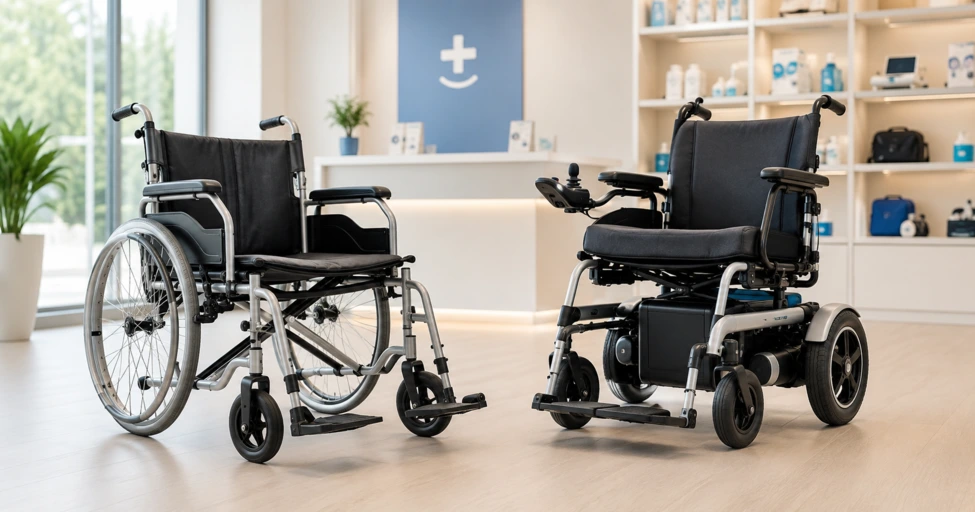
You’re standing in a mobility equipment shop, or scrolling through a website at midnight, staring at two very different chairs. One looks simple. The other has a joystick and a battery pack. Someone you love needs one of them, and you’re not sure which.
That decision matters more than most people realize. The right wheelchair affects daily comfort, independence, and how much strain falls on the person pushing it. The wrong one gets left in a corner within a month.
This post walks through the real differences between a manual vs electric wheelchair, so you can pick based on strength, lifestyle, budget, and daily needs, not guesswork.
What Is a Manual Wheelchair?
A manual wheelchair is a chair with wheels that moves when you push it. No motor, no battery. Just you, or someone helping you, providing the force.
How It Works and Who Uses It
Most manual wheelchairs have large rear wheels with a handrim attached. The person sitting in the chair grips the handrim and pushes it forward to roll. If the user can’t do that, an attendant pushes from behind using the handles on the back of the chair.
Manual wheelchairs work well for people recovering from surgery, managing a temporary injury, or living with a condition that limits leg mobility but not arm strength. They’re also common in hospitals, where staff push patients between rooms and departments.
Main Types
- Self-propelled: Large rear wheels the user can grip and push. Built for people with decent upper-body strength.
- Transit or attendant-propelled: Smaller wheels, no handrim. Designed to be pushed by a caregiver, not the user.
- Commode wheelchairs: Combine mobility with a built-in commode seat, useful for home care and hospital settings. The Kaiyang KY608 commode wheelchair is a common choice for patients who need both functions in one chair.
Benefits of Manual Wheelchairs
Manual chairs are lightweight, which makes them easy to lift into a car trunk or carry up a flight of stairs. They’re also more affordable than electric models, with a simpler design that rarely breaks down. There’s no battery to charge and no motor to service. For short-term recovery or occasional use, a manual chair like the carbon steel durable wheelchair covers most needs without the extra cost.
Limitations of Manual Wheelchairs
The catch is effort. Pushing a manual wheelchair requires real arm strength, and that strength has to come from somewhere, either the user or a caregiver. Long distances get tiring fast. Ramps, gravel, and uneven pavement make things harder still. If the user has limited upper-body strength or the caregiver has back problems, a manual chair can become a daily struggle rather than a solution.
What Is an Electric Wheelchair?
An electric wheelchair, also called a power wheelchair, moves on its own. A battery powers the motor. A joystick tells it where to go.
How the Joystick and Motor Work
The user pushes the joystick in the direction they want to move, and the motor does the rest. No pushing, no gripping wheels. It’s essentially a small, precise vehicle built for one person. Turning, stopping, and adjusting speed all happen through that single control, which makes it usable even for people with very limited hand strength.
Main Types
- Indoor models: Compact and easy to maneuver through doorways and tight hallways.
- Outdoor and all-terrain models: Larger wheels, more power, built to handle slopes, grass, and rougher ground.
- Foldable electric wheelchairs: Designed to fold down for car trunks or air travel, like the Dayang folding electric wheelchair.
Benefits of Electric Wheelchairs
The biggest advantage is effort, or the lack of it. Someone with limited upper-body strength can still move independently, without relying on a caregiver to push. Electric chairs handle longer distances without wearing the user out, and many people find the joystick easier to control than pushing a handrim. Some models also offer adjustable seating and positioning, which helps with pressure sores and long-term comfort. The Kaiyang Smart Electric Wheelchair is a good example of a model built with these comfort features in mind.
Limitations of Electric Wheelchairs
Power comes at a cost. Electric wheelchairs are more expensive to buy, heavier to transport, and need regular charging to stay usable. If the battery dies mid-trip, the chair becomes very hard to move manually. Maintenance is also more involved, since there’s a motor, battery, and electronics to look after instead of just wheels and a frame.
Manual vs Electric Wheelchair: Key Differences
| Factor | Manual Wheelchair | Electric Wheelchair |
|---|---|---|
| Price | Lower | Higher |
| Weight | Lighter | Heavier |
| Portability | Easy to fold and carry | Harder to transport, some models fold |
| Ease of use | Requires practice and strength | Easier once joystick control is learned |
| Physical effort | High | Minimal |
| Battery requirements | None | Regular charging needed |
| Maintenance | Simple | More involved |
| Indoor use | Good, but bulky in tight spaces | Good, especially compact models |
| Outdoor use | Difficult on slopes and rough ground | Better suited for outdoor terrain |
| Travel | Easy to fold and check in | Battery rules apply, more planning needed |
| Comfort | Basic seating | Some models offer adjustable positioning |
| Long-distance mobility | Limited by fatigue | Strong |
Which One Fits Your Life?
Choose a Manual Wheelchair If:
You have enough upper-body strength to push yourself, or a caregiver who can push you comfortably. You only need the chair occasionally, maybe during recovery from an injury or surgery. You want something light and affordable that’s easy to fold and toss in a car. You move the chair often, between home, car, and appointments.
Choose an Electric Wheelchair If:
Your arms and shoulders can’t handle regular pushing. You’re in the chair most of the day, not just for short trips. You need to cover longer distances, whether that’s a large hospital, a market, or getting around outdoors. You want powered movement that doesn’t leave you or your caregiver exhausted by evening.
What Should You Consider Before Buying a Wheelchair?
Start with the user’s actual strength and mobility, not what seems easiest to buy. Think about how often the chair will be used. A chair for daily, all-day use has different requirements than one for occasional trips to the clinic.
Check the home. Are doorways wide enough? Are there stairs without a ramp? Look at the vehicle too. Some cars can’t fit a folded electric wheelchair without a lift or ramp.
Weight and portability matter if the chair moves in and out of a car often. For electric models, ask about battery range and how long a full charge lasts. Seat width, depth, and cushioning affect comfort over long periods, especially for people who sit in the chair most of the day.
Manual vs Electric Wheelchair Cost
Manual wheelchairs cost less upfront and stay cheap to maintain, since there’s no battery or motor involved. Electric wheelchairs cost more to buy, and there are ongoing expenses to plan for. Batteries wear out over time and need replacing every couple of years with regular use. Motors and joystick controllers can also need servicing eventually. Factor these costs in before comparing sticker prices alone.
Budget matters, but so does warranty and after-sales support. A cheaper chair with no service backup can end up costing more in the long run.
Is an Electric Wheelchair Difficult to Travel With?
Short answer: it depends on the airline and the battery.
Flying With a Power Wheelchair
Airline rules around lithium battery-powered wheelchairs have gotten stricter recently. Southwest Airlines, for example, now requires passengers to remove lithium batteries from mobility devices and carry them into the cabin separately, after the wheelchair itself is checked as baggage. The airline has also placed a limit on battery size, capping lithium batteries at 300 watt-hours or less. Other US carriers have their own versions of these rules, so it’s worth calling ahead before you fly with an electric wheelchair.
Folding and Car Transport for Manual Chairs
Manual wheelchairs are simpler here. Most fold flat, fit in a car trunk without much effort, and don’t come with battery restrictions at the airport. If travel is a regular part of your life, that simplicity is worth factoring into your decision.
Mistakes People Make When Choosing a Wheelchair
- Choosing based on price alone, without checking if the chair actually fits the user’s strength and daily needs
- Ignoring the chair’s weight and dimensions, then struggling to fit it through doorways or into a car
- Buying without measuring the user’s seat width, depth, and height first
- Forgetting how often the chair needs to be transported, and picking something too heavy for that
- Not thinking about where the chair will actually be used most, indoors, outdoors, or both
- Skipping questions about warranty and after-sales service until something breaks
Frequently Asked Questions
Is a manual or electric wheelchair better?
Neither is better across the board. It depends on the user’s strength, how often the chair is used, and the budget available.
Q. Which wheelchair is easier to use?
A. Electric wheelchairs are usually easier once the user learns the joystick, since they don’t require physical strength to move. Manual wheelchairs need practice and upper-body effort.
Q. Is an electric wheelchair worth the extra cost?
A. For someone using a wheelchair most of the day with limited arm strength, yes. For occasional or short-term use, a manual chair is usually the more practical choice.
Q. Can a manual wheelchair be used outdoors?
A. Yes, but slopes, gravel, and uneven ground make it harder. Manual chairs work best on flat, paved surfaces.
Q. How long does an electric wheelchair battery last?
A. Most batteries last a full day of normal use on a single charge, with range varying by model. Battery lifespan itself, before needing replacement, is usually a couple of years with regular use.
Q. Are electric wheelchairs difficult to transport?
A. They’re heavier than manual chairs, and some models don’t fold as compactly. Foldable electric models exist for people who travel often.
Q. Which wheelchair is better for elderly users?
A. It depends on the individual. Many elderly users benefit from electric wheelchairs if arm strength has declined, but a lightweight manual chair works fine for those who are still mobile and only need occasional support.
Q. Can insurance or assistance programs cover a wheelchair?
A. Coverage varies widely depending on your location and provider. It’s worth asking your healthcare provider or local assistance programs directly, since policies differ.
Conclusion
There’s no single best wheelchair for everyone. A manual chair works well for people with the strength to push themselves, or occasional use where cost and portability matter most. An electric chair makes more sense for people who need powered movement, longer distances, and less physical strain on a daily basis.
Think about mobility, comfort, lifestyle, and budget together, not just one factor. If you’re unsure, talk to a healthcare or mobility professional before deciding. Marium Oxygen carries a full range of manual and electric wheelchairs suited to different needs and budgets, so you can find the right fit for your situation.
Call us at 01714558407.