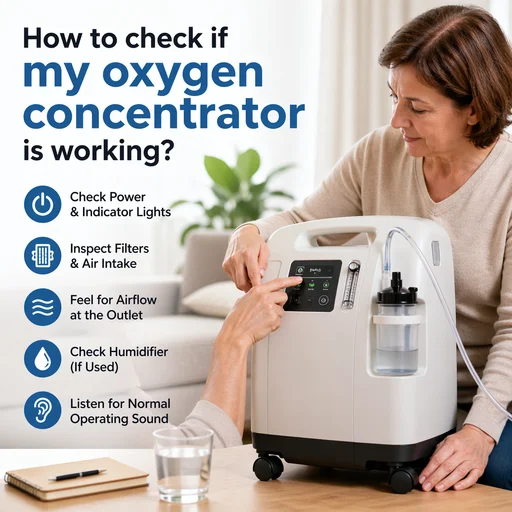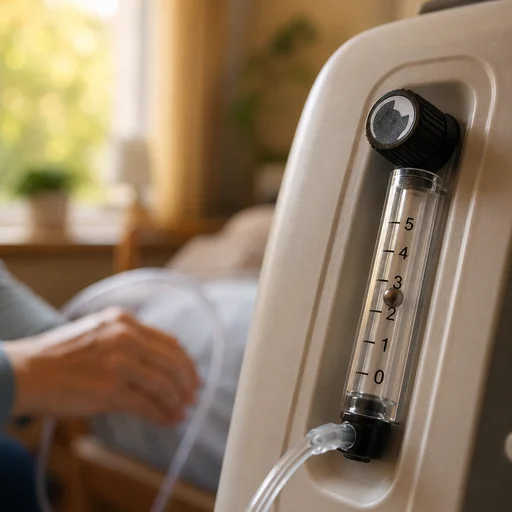
You’re sitting next to a relative’s bed. The concentrator hums in the corner. A small ball floats inside a clear tube, and next to it is a number: 2, 4, 6, maybe higher. That number is the flow rate. It decides exactly how much oxygen reaches your loved one’s lungs every minute.
Most families never get a clear explanation of what that number means. They just know the doctor said “set it to 3,” so they did. But oxygen isn’t something you turn up just because someone looks short of breath. A safe oxygen flow rate depends on the person, their condition, and the device delivering it. Get it wrong in either direction, and there are real consequences.
This guide walks through what the 1 to 15 LPM range actually means, who needs which setting, and how to tell if something’s off.
What Does Oxygen Flow Rate Actually Mean?
Flow rate is measured in liters per minute, or LPM. It’s how many liters of oxygen leave the machine and enter the tubing every 60 seconds. Think of it less like a thermostat and more like a tap. Turn it up, more oxygen flows. Turn it down, less does.
LPM vs FiO2: What’s the Difference?
LPM tells you the volume of oxygen flowing. FiO2 tells you the percentage of oxygen the person is actually breathing in, once that flow mixes with regular room air.
Room air on its own is about 21% oxygen. According to clinical guidance on inspired oxygen fraction, each extra liter of flow through a nasal cannula raises that percentage by roughly 4%. So 1 LPM puts you around 24%. 4 LPM gets you closer to 36%.
This is why the number on the dial doesn’t tell the whole story. It’s the FiO2, the real percentage hitting the bloodstream, that decides whether the dose is doing its job.
What’s a Safe Oxygen Flow Rate Across the 1–15 LPM Scale?
Different ranges exist because different equipment and different situations call for them. A typical home oxygen prescription falls between 1 and 10 LPM. Anything past that usually means a hospital-grade mask, not a home cannula.
1–6 LPM: The Nasal Cannula Range
This is where most home care patients live. A standard nasal cannula maxes out around 4 to 6 LPM. Push it higher and it stops adding much oxygen anyway. Instead it just dries out the nose and throat. Most COPD and long-term home oxygen patients sit somewhere between 1 and 4 LPM.
6–15 LPM: Masks and High-Flow Devices
Past 6 LPM, a nasal cannula isn’t enough device to do the job properly. Simple face masks typically run 6 to 10 LPM. Non-rebreather masks, the kind used in hospitals for serious oxygen drops, go up to 15 LPM and can deliver 60% to 90% oxygen. That top end of the scale almost never applies to stable home care. It’s reserved for acute, closely monitored situations.
| Device | Flow Rate (LPM) | Approx. FiO2 |
|---|---|---|
| Nasal cannula | 1–6 | 24%–48% |
| Simple face mask | 6–10 | 35%–60% |
| Non-rebreather mask | 10–15 | 60%–90% |
Who Needs Which Flow Rate?
The honest answer is: it depends on the condition, and the target isn’t the same for everyone.
Why Do COPD Patients Need a Lower Target?
If you or a family member has COPD, the doctor probably aimed for a lower number than you’d expect. Many COPD patients struggle to clear carbon dioxide, not just take in oxygen. Push their oxygen saturation too high, and it can suppress their normal drive to breathe, leading to a buildup of CO2 called hypercapnia.
That’s why respiratory guidelines from the European Respiratory Society and the Thoracic Society of Australia and New Zealand both recommend a target saturation of 88% to 92% for COPD patients at risk of this, rather than pushing them into the high 90s like a healthy person.
What’s a Normal Target for Other Conditions?
For most other patients, without chronic lung disease, the target is higher: 94% to 98%. This covers people recovering from pneumonia, post-surgical patients, or anyone using oxygen short-term. The flow rate needed to hit that range is something the doctor sets based on a blood oxygen reading, not a guess.
What Happens If the Flow Rate Is Too High?
It’s a common assumption that more oxygen is always safer. It isn’t. Breathing in too much oxygen for too long can irritate and eventually damage lung tissue, a condition known as oxygen toxicity.
What Are the Warning Signs of Too Much Oxygen?
According to health resources on oxygen toxicity, the early signs are easy to miss if you don’t know to look for them:
- Dry cough or a burning feeling in the chest
- Throat irritation or dryness
- Dizziness or blurred vision
- Unusual drowsiness or confusion
In home care, this almost always traces back to one thing: the flow rate setting being higher than what was prescribed, whether by accident or because someone bumped it up on their own. If you notice these signs, don’t touch the dial yourself. Call the doctor or check with a pulse oximeter first.
How Do You Know What Setting Is Right for You?
The flow rate isn’t a number you pick because it feels right. It’s a prescription, set by a doctor based on a blood gas test or a pulse oximeter reading. Think of it the same way you’d think of a medication dose. Too little doesn’t treat the problem. Too much causes a different one.
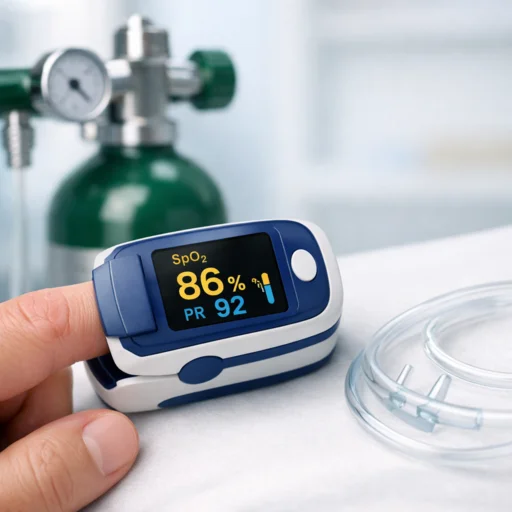
A pulse oximeter clipped to the finger gives you a quick read of oxygen saturation at home, which is useful for keeping an eye on things between doctor visits. It doesn’t replace a prescribed setting, but it tells you when something’s worth calling about.
Can I Adjust My Own Flow Rate?
Short answer: no. Even if someone looks more breathless one day, the right move is to check their oxygen saturation and call the doctor, not raise the dial. Flow rate changes should come from whoever is managing the medical care, not from guesswork at the bedside.
Choosing the Right Equipment for Your Prescribed Range
Concentrator vs Cylinder: Which One Fits Your Number?
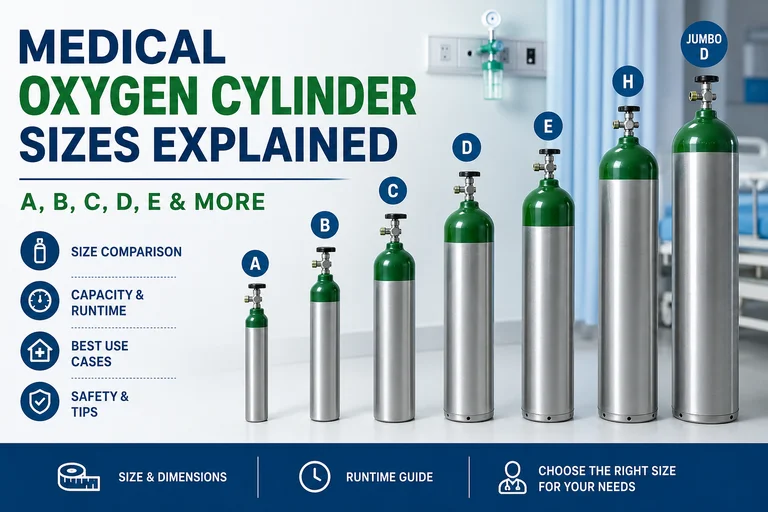
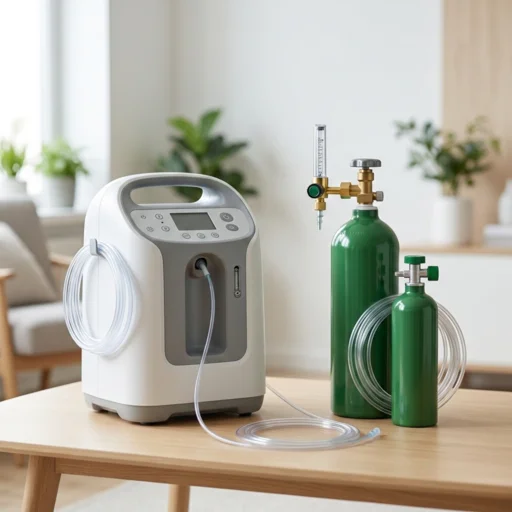
If the prescription sits in the 1 to 5 LPM range, a stationary oxygen concentrator usually covers it well for continuous home use. For higher flow needs, backup during power cuts, or short hospital-style support, oxygen cylinders are often the more practical option. Some families keep both on hand, one for daily use and one as backup.
In plain terms
A safe oxygen flow rate is the one your doctor prescribed, not the one that feels comfortable in the moment. Too little oxygen leaves the body short. Too much carries its own risks. The number on the dial only matters in relation to that specific prescription, checked regularly with a pulse oximeter.
Whether you need to buy a concentrator, pick up a cylinder, or are looking at renting a cylinder for short-term care, or need our refill service to keep your supply topped up, we can help you get set up correctly.
Call us at 01714558407 for buying, renting, or refilling oxygen equipment.