You walk into a supplier’s shop looking for an oxygen cylinder, and someone points to a wall of tanks labeled A, B, C, D, E, H. No one explains what any of it means. You just need to know which one keeps your father breathing through the night without running out at 3 A.M.
That’s the real question behind oxygen cylinder sizes. It’s not about letters. It’s about how much oxygen you get, how long it lasts, and whether you can actually carry it. Let’s break it down properly.
What Do Oxygen Cylinder Sizes Actually Mean?
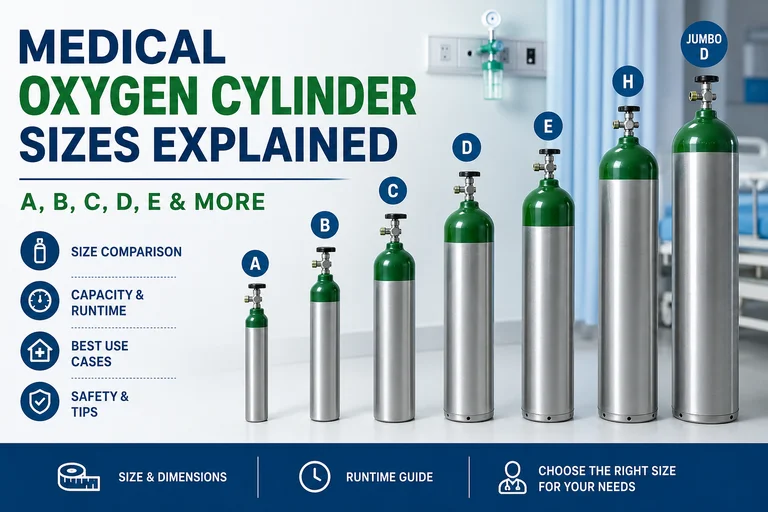
Oxygen cylinder sizes follow an old alphabetical system. It starts at A for the smallest tank and moves up toward H and beyond for the largest ones used in hospitals.
Each letter roughly tells you how much oxygen the cylinder holds and how big it is physically. But here’s the catch: manufacturers use two different naming systems. The older one goes A through E, and a newer one uses “M” followed by a number that represents cubic feet of oxygen inside. So a B cylinder might also be called an M6 depending on where you bought it.
Dimensions and exact capacity can also shift a little between suppliers. Always check the label on the tank itself, not just the size name, before you rely on it for a specific flow rate.
Oxygen Cylinder Size Chart: Capacity, Weight, and Uses
Here’s a quick reference for the sizes you’ll come across most often.
| Cylinder Size | Approx. Capacity | Approx. Weight (Full) | Typical Use |
|---|---|---|---|
| A | ~164 L | Light, hand-carry | Very short-term, emergency use |
| B (M6) | ~255 L | Light, hand-carry | Short trips, small emergency kits |
| C | ~570 L | ~6 kg | Portable use with a trolley or carry bag |
| D | ~1,900 L | ~16 kg | Home oxygen therapy, ambulances, clinics |
| E | ~4,300 L | ~40 kg | Hospitals, ambulances, backup supply |
| H | ~7,000 L+ | 60+ kg | Hospitals, central supply, long-term care |
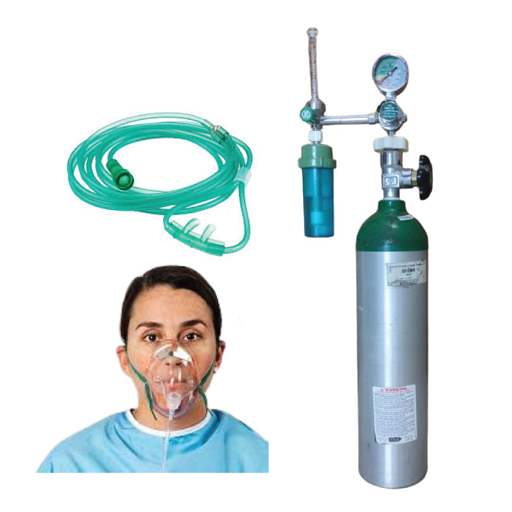
C cylinders stay easy to carry with a medical trolley or bag despite holding more oxygen than a B tank. D cylinders hold nearly double that and remain some of the largest cylinders still considered portable, which is why they show up so often in home care. Once you move to E and above, portability drops fast. Those tanks are built for a fixed spot, not a shoulder bag.
If you’re shopping for your own supply, browse oxygen cylinders to see what’s available in Bangladesh right now.
Why Are D and E Cylinders the Most Common Sizes?
Ask any home care nurse which cylinder they reach for first, and the answer is almost always D or E. Here’s why.
D cylinders hit a sweet spot. They hold enough oxygen for several hours of use, but one person can still lift and move them without help. That makes them the default choice for patients managing COPD, pneumonia recovery, or post-surgical care at home.
E cylinders trade some of that portability for capacity. They’re one of the most common sizes used in medical settings, especially in hospitals where a steady, larger supply matters more than easy carrying. Ambulances stock them for the same reason. When a patient needs oxygen during transport, an E cylinder buys enough time to reach the hospital without a mid-route swap.
How Long Does Each Oxygen Cylinder Size Last?
This is the question that actually matters day to day. A cylinder’s size means nothing if you don’t know when it’ll run dry.
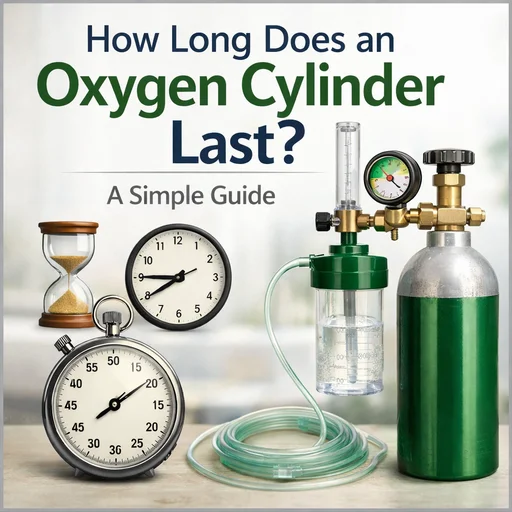
The basic formula is: duration in minutes equals cylinder pressure multiplied by a cylinder-specific conversion factor, divided by the flow rate. Each cylinder size has its own factor because the factor accounts for both the tank’s volume and its maximum pressure. Most guidance also builds in a safety buffer, since regulators lose accuracy and can let room air leak in once the pressure drops too low.
You don’t need to memorize the math. A rough runtime chart does the job:
| Cylinder Size | 1 LPM | 2 LPM | 3 LPM | 5 LPM |
|---|---|---|---|---|
| D | ~6.9 hrs | ~3.5 hrs | ~2.3 hrs | ~1.4 hrs |
| E | ~11.4 hrs | ~5.7 hrs | ~3.8 hrs | ~2.3 hrs |
Higher flow rate, shorter runtime. It’s a straight trade-off. If your doctor has you on 2 LPM continuous flow, a D cylinder gives you roughly three and a half hours before you need a fresh one. Plan your refill schedule around that number, not around guesswork.
Which Oxygen Cylinder Size Is Best for Home Use?
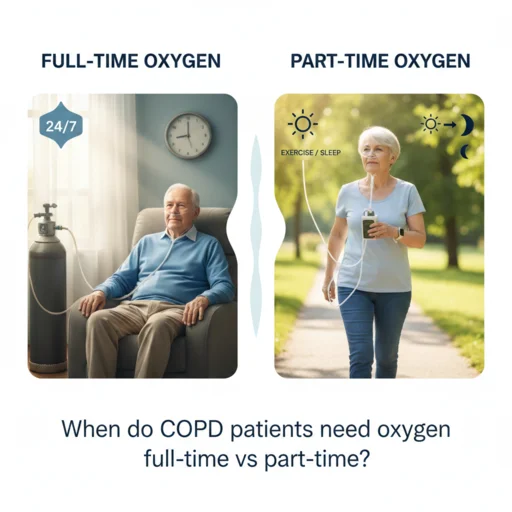
Short answer: it depends on how often you need oxygen, not just how sick someone is.
If oxygen is only needed occasionally, for short bursts during a bad day or as backup during a power cut, a D cylinder covers most situations without taking up your whole bedroom. If someone needs oxygen for most of the day, every day, cylinders start to feel impractical fast. You’d be swapping tanks constantly.
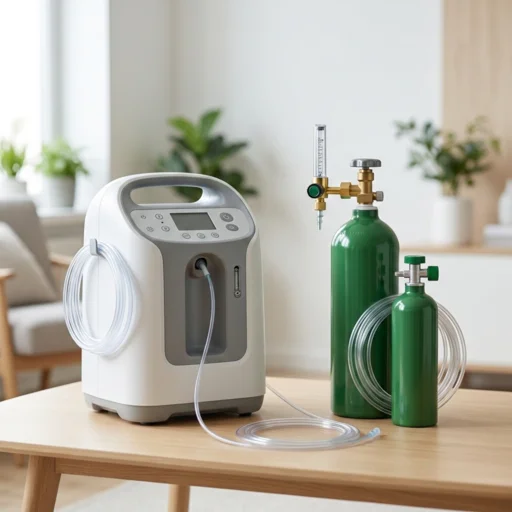
That’s usually the point where a doctor moves a patient from cylinders to a concentrator, since concentrators are meant for continuous, all-day use rather than short bursts. If you’re not sure which category you fall into, that’s a conversation for your doctor, not a guess based on a size chart.
Not ready to commit to buying? Look into renting an oxygen cylinder first, especially if this is a temporary need after surgery or an illness.
Oxygen Cylinder vs. Oxygen Concentrator — Which One Do You Need?
Think of a cylinder as a bucket of water and a concentrator as a running tap. One has a fixed amount. The other keeps producing as long as it’s plugged in.
Concentrators typically deliver 90 to 96 percent oxygen purity, which covers most home users, while cylinders deliver oxygen at closer to 100 percent purity, assuming they’re filled and maintained properly. The trade-off is power. Cylinders work during outages. Concentrators don’t, unless you’ve got a battery backup.
Cylinders tend to make more sense for short-term needs, emergency backup, or homes without reliable electricity, while concentrators work out cheaper and simpler for daily, long-term therapy. Many families in Bangladesh keep both: a concentrator for daily use and a cylinder as backup. If that sounds like your situation, an oxygen concentrator alongside a cylinder covers both scenarios.
Final Thoughts
Oxygen cylinder sizes aren’t complicated once you strip away the letters. What matters is your flow rate, how long you need oxygen to last, and whether you can actually carry the tank yourself.
For most home care situations, a D cylinder covers you well. For hospitals, ambulances, and backup supply, E and larger sizes make more sense. If you’re not sure which fits your case, ask your doctor for the flow rate first. Everything else follows from that number.
We stock almost all types of oxygen cylinder, a reliable option for home and clinical use, along with rental and refill options if you’re not ready to buy outright.
Call us at 01714558407.