You’ve probably seen one clipped to a finger in a hospital room. Maybe you bought one during COVID and forgot what half the numbers mean. Either way, the pulse oximeter is one of those small devices that carries a lot of weight, and most people don’t fully understand what it’s telling them.
Let’s fix that.
What Is a Pulse Oximeter?
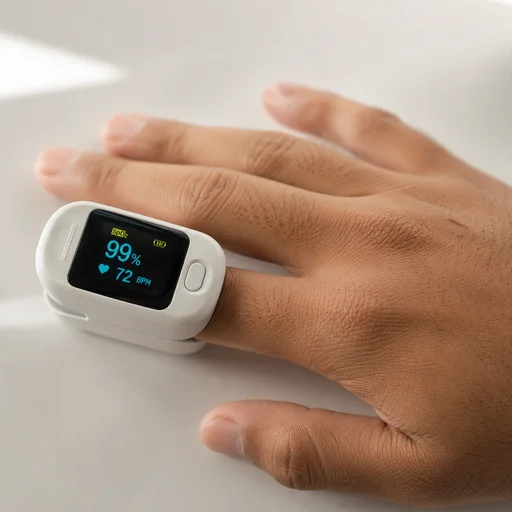
A pulse oximeter is a device that is usually clipped on a fingertip. It uses light beams to estimate a person’s blood oxygen level and their pulse rate, without needing to draw any blood.
That’s the short version. No needles. No lab. Just a small clip and a reading within seconds.
It can be used in critical care settings like emergency rooms and hospitals, during rehabilitation exercise therapy, or right at home. The device is portable, affordable, and genuinely useful for anyone managing a respiratory or heart condition.
How Does a Pulse Oximeter Work?
Here’s where it gets interesting.
The sensor contains two light-emitting diodes, one red and one infrared. Oxygenated blood absorbs more infrared light, allowing more red light to pass through. Deoxygenated blood does the opposite. The device calculates the ratio of absorbed light to determine your oxygen saturation percentage. It also measures your pulse rate as blood volume changes with each heartbeat, displaying this as beats per minute.
So when you clip it on, the device is essentially shining light through your finger and reading what comes out the other side. Simple in concept. Remarkably accurate in practice.
For best results, make sure the hand is warm, placed below heart level, the finger is clean without any nail polish or jewelry, and you are relaxed. Sit still and do not move your hand. Wait a few seconds for the readings to settle.
What Does SpO2 Mean?
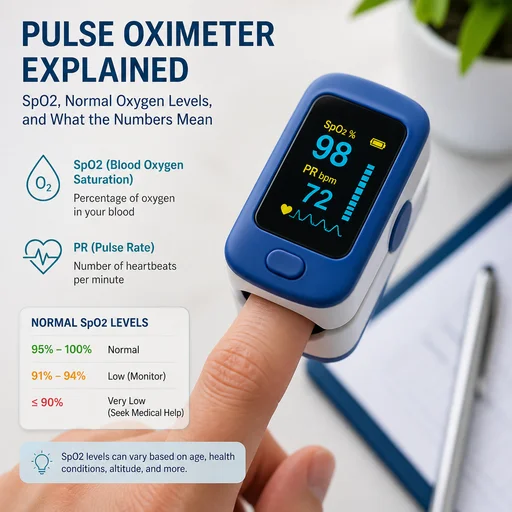
SpO2 stands for peripheral oxygen saturation. It’s a percentage that tells you how much of your hemoglobin is carrying oxygen.
SpO2 is a measure of the amount of oxygen-carrying hemoglobin in the blood compared to the amount of hemoglobin that is not carrying oxygen. There needs to be a particular amount of oxygen present in the blood at all times, or the body cannot function properly.
Think of hemoglobin as tiny delivery trucks in your bloodstream. SpO2 tells you what percentage of those trucks are loaded with oxygen right now. At 98%, nearly all of them are carrying their cargo. At 88%, a meaningful number are running empty.
What Is a Normal Oxygen Level?
Oxygen saturation values are between 95% and 100% for most healthy individuals, but sometimes can be lower in people with lung and heart problems. Oxygen saturation levels are also generally slightly lower for those living at higher altitudes.
An ideal oxygen level is between 96% and 99%. That’s the sweet spot. If you’re regularly hitting numbers in that range, your lungs and blood are doing their job well.
What Oxygen Level Is Considered Low?
This is where you need to pay attention.
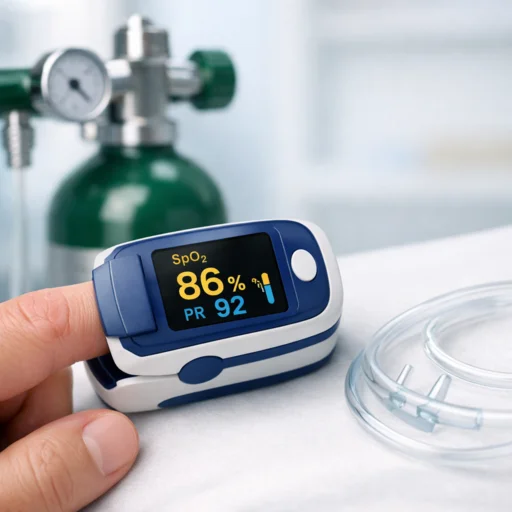
SpO2 values below 95% are considered abnormal, and caution should be taken at these values. Patients with an SpO2 reading of less than 90% are said to be hypoxemic. Patients with a reading below 85% would be severely hypoxemic.
To put that simply: 95% or above, you’re generally fine. Between 90% and 94%, something may be wrong and you should consult a doctor. Below 90%, that’s a medical situation that needs attention fast.
If you or someone in your household has a chronic condition like COPD, asthma, or heart disease, monitoring these numbers regularly matters. A pulse oximeter kept at home means you catch a drop early, before things get serious.
What Is the Difference Between Pulse Rate and Oxygen Level?
People often confuse these two readings because they appear on the same screen. They’re measuring entirely different things.
Your SpO2 tells you how much oxygen is in your blood. Your pulse rate (sometimes shown as PR or BPM) tells you how fast your heart is beating.
The normal pulse rate for adults at rest typically ranges between 60 and 100 beats per minute. This varies with age, fitness level, and medical conditions.
One measures oxygen. The other measures heart speed. Both matter. Neither one tells the full story on its own.
What Is a Good Pulse Rate Reading?
An ideal heart rate is between 50 and 90 beats per minute. Some sources put the upper end at 100 BPM for healthy adults at rest. Athletes often sit lower, sometimes in the 40s, because their hearts are stronger and more efficient.
A consistently high resting heart rate above 100 BPM, or a very low one below 50 BPM without a fitness explanation, is worth discussing with a doctor.
Knowing the Numbers Is Half the Battle
A pulse oximeter gives you two critical data points: how well your blood is carrying oxygen, and how hard your heart is working to move it. Together, they paint a quick picture of your respiratory and cardiovascular health.
If you’re managing a condition that affects breathing, or caring for someone who is, having a reliable device at home isn’t a luxury. It’s practical. Marium Oxygen carries a range of pulse oximeters suited for home and clinical use, along with oxygen concentrators and oxygen cylinders for those who need supplemental oxygen support.
Check your readings. Know your baselines. And when numbers drop outside the normal range, don’t wait.