If you’ve just started using an oxygen concentrator at home, you’ve probably noticed it’s not silent. There’s a hum. Maybe a faint click every few seconds. At first, every sound feels like something to worry about.
Here’s the good news: most of that noise is completely normal. An oxygen concentrator pulls in air, filters out nitrogen, and pushes concentrated oxygen out through your tubing. That process needs a compressor, a cooling fan, and a set of internal valves, and all three make sound while they work.
But not every noise is harmless. Some sounds mean it’s time to check the machine, and a few mean it’s time to call for help. This guide walks you through both, so you know exactly what to listen for.
Do Oxygen Concentrators Normally Make Noise?
Short answer: yes, always. There’s no such thing as a completely silent oxygen concentrator.
Why oxygen concentrators make noise
Four parts inside the machine create sound during normal operation:
- The compressor. This is the core of the machine. It pressurizes air so oxygen can be separated from nitrogen, and it runs more or less continuously.
- The cooling fan. Concentrators generate heat, and the fan pulls that heat away so the machine doesn’t overheat.
- Air intake and exhaust. Air moving in and out of the unit creates a soft whooshing sound.
- Internal valves. These open and close as the machine cycles through its filtration process, which can produce light clicking.
What a normal oxygen concentrator sounds like
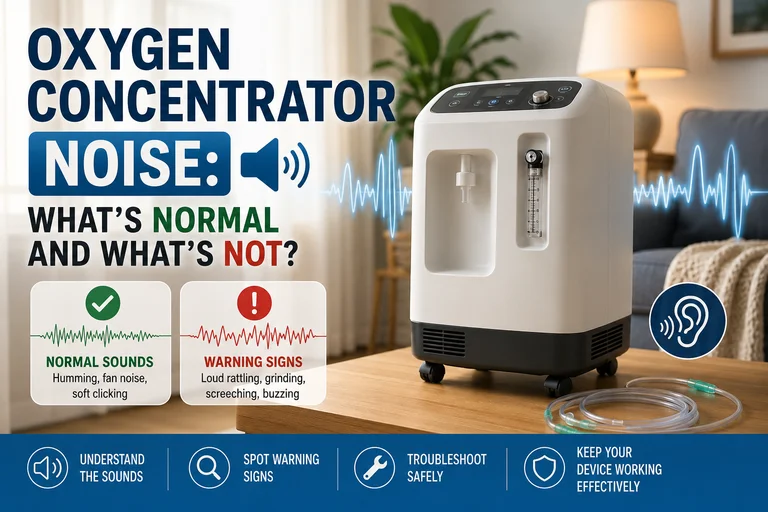
A healthy machine typically produces a steady hum, sometimes described as similar to a small refrigerator or a white noise machine. You might also hear:
- A soft, consistent buzzing from the fan
- Occasional light clicking as internal valves open and close
- A slight change in tone when the compressor cycles
This kind of sound comes from the motor and compressor working together to deliver a steady flow of oxygen, and it’s often low-pitched enough to blend into the background. If you can hold a conversation next to your machine without raising your voice, it’s almost certainly within a normal range.
How loud is a typical oxygen concentrator?
This depends heavily on the model. Stationary home units tend to run louder than portable ones, and older machines are usually louder than newer ones. Rather than memorizing one number, check your unit’s manual for its rated decibel level.
That said, here’s a general sense of where things stand:
| Sound Level | What It Feels Like |
|---|---|
| 35–40 dB | Whisper or quiet library |
| 40–48 dB | Light rainfall or a quiet office |
| 48–55 dB | Quiet conversation at home |
| Above 55 dB | Approaching normal conversation volume |
Most concentrators fall somewhere between a whisper and normal conversation volume, roughly 35 to 55 decibels. Anything consistently louder than that, especially without a clear cause, is worth a closer look.
Common Oxygen Concentrator Sounds and What They Mean
Here’s a quick reference table you can come back to whenever a new sound catches your attention.
| Sound | Usually Normal? | Possible Cause |
|---|---|---|
| Soft humming | Yes | Compressor |
| Fan noise | Yes | Cooling system |
| Light clicking | Often | Internal valves |
| Air whooshing | Often | Airflow |
| Occasional vibration | Sometimes | Compressor or placement |
| Loud rattling | No | Loose or damaged component |
| Grinding | No | Mechanical problem |
| Screeching | No | Fan or motor issue |
| Repeated loud buzzing | Usually no | Electrical or mechanical issue |
| Sudden change in sound | Needs attention | Possible malfunction |
If your machine falls anywhere in the top half of this table, you likely don’t need to do anything. The bottom half is where it’s worth pausing.
Oxygen Concentrator Making a Loud Noise: Possible Causes
If your concentrator has gotten noticeably louder, work through these possibilities before assuming the worst.
The machine is on an unstable surface
An uneven floor or a wobbly table can turn normal compressor vibration into a rattle. Move the unit to a flat, solid surface and see if the sound changes.
Air filters are dirty or blocked
A blocked filter forces the machine to work harder to pull in air, which increases strain and noise. Dirty filters can strain the machine, making it louder as it works to compensate. Clean or replace filters on the schedule listed in your manual.
Air intake or exhaust is blocked
If the machine is pushed too close to a wall, or if a curtain or blanket is covering the vents, airflow gets restricted. This makes the fan work harder and often louder.
The cooling fan is dirty or malfunctioning
Dust buildup on the fan blades, or a fan bearing that’s starting to wear out, can turn a soft hum into a whine or a scrape. The fans inside the concentrator cool the system and keep airflow constant for the filtration process, so a struggling fan tends to announce itself.
Compressor vibration
Some vibration from the compressor is completely normal. It only becomes a concern when it’s strong enough to shake the table it’s sitting on or rattle nearby objects.
Worn or damaged internal components
If you’ve ruled out placement, filters, and vents, and the noise is still there, an internal part may be wearing down. This isn’t something to diagnose or fix yourself. It’s a job for a qualified technician.
Rattling, Buzzing, or Clicking: What’s the Difference?
Different sounds point to different causes. Here’s how to tell them apart.
Rattling often means something is loose, whether that’s a panel, a wheel, or a piece of tubing resting against the housing. Loose tubing, cracked connectors, or wheels that aren’t sitting evenly can all create this kind of noise, and it’s usually fixable without opening the machine.
Buzzing at a low, steady volume is normal fan behavior. A sudden or unusually loud buzz is different and worth checking.
Clicking from internal valves is expected and happens in short bursts. Continuous or gradually louder clicking is not.
Hissing can come from normal airflow, but persistent hissing that wasn’t there before may point to a leak somewhere in the tubing or connections.
When Is Oxygen Concentrator Noise a Warning Sign?
Pay closer attention when any of the following happen:
- The noise suddenly gets louder
- The machine starts making a sound you haven’t heard before
- You hear grinding or screeching
- Strong vibration develops
- The unit feels unusually hot
- An alarm sounds
- Oxygen flow seems reduced
- The display shows an error
- The machine keeps shutting down on its own
- There’s a burning smell or visible electrical damage
A harsh change in sound usually points to a problem with the fan, compressor, or a loose internal part. If you notice a burning smell, smoke, or any sign of electrical damage, turn the machine off, switch to backup oxygen if you have it, and contact your supplier right away. Don’t try to troubleshoot this part yourself.
How to Reduce Oxygen Concentrator Noise Safely
Most noise problems come down to a handful of fixable issues.
Place it correctly
Set the machine on a stable, level surface, away from walls and curtains, with enough clearance for air to move freely. Check your manual for the exact clearance your model needs.
Clean the user-serviceable filter
Every model is a little different, so follow the cleaning instructions in your manual rather than guessing. A clean filter alone often solves a noise problem that felt mysterious.
Check external tubing and connections
Look for kinks, and make sure connectors are seated properly. Keeping tubing from resting against the machine’s housing, wheels, or a wall prevents it from buzzing with airflow vibration.
Reduce vibration
A firm, level surface helps here too. Avoid placing the unit directly against furniture, since that can amplify vibration instead of absorbing it. Just don’t block the vents in the process.
Don’t open the machine yourself
Internal components involve both electrical and mechanical parts. Any repair beyond external cleaning and filter maintenance should go to a qualified technician.
Should You Be Concerned If It Gets Louder at Night?
Usually not. A quiet bedroom makes every sound more noticeable, so a machine that felt fine during the day can suddenly seem loud at 11 p.m. That’s often a change in your environment, not the machine.
That said, if the sound itself is genuinely different, not just more noticeable, treat it the same way you would during the day. And never reposition the machine in a way that blocks its ventilation, even if it means the sound carries a little further.
Can Oxygen Concentrator Noise Affect Sleep?
For light sleepers, yes, continuous background noise can be disruptive. If noise is disturbing sleep, using a longer oxygen tube lets you place the machine in another room while still receiving your prescribed oxygen. Some newer models are also built specifically to run quieter, which is worth considering if noise has become a recurring issue.
One thing not to do: don’t cover the concentrator with blankets or fabric to muffle the sound. That blocks ventilation and can cause overheating.
Portable vs. Stationary Oxygen Concentrator Noise
Stationary concentrators
These are built for continuous home use, and their compressor and fan noise tends to be more noticeable since the units are larger and run around the clock.
Portable oxygen concentrators
Smaller compressors and fans generally mean less noise, though this varies a lot by model. Portable units typically run below 50 decibels, and machines using pulse-dose delivery (which release oxygen only when you inhale) often sound different from continuous-flow machines, which run steadily.
What to compare when buying
If noise is a priority, compare:
- The manufacturer’s listed noise level
- Whether the unit offers continuous-flow, pulse-dose, or both
- Battery life, if portability matters to you
- Warranty coverage and local service availability
If you’re weighing your oxygen concentrator options, it’s worth deciding upfront whether you need a stationary unit for constant home use or a portable oxygen concentrator for flexibility. Noise level is one factor among several, but it’s one people often overlook until after they’ve bought the machine.
Simple Troubleshooting Checklist
Work through these questions before assuming something’s seriously wrong:
- Is the noise new?
- Is it louder than usual?
- Is the machine on a stable surface?
- Are the air vents clear?
- Is the filter clean, per the manufacturer’s instructions?
- Are the tubing and connections secure?
- Is the machine overheating?
- Are there any alarms or error messages?
- Has your oxygen flow changed?
- Does the noise continue after all the basic checks?
If you’ve been through this list and the noise is still there, it’s time to reach out to our team or your equipment supplier rather than continuing to troubleshoot on your own.
Final Takeaway
Some noise is part of how an oxygen concentrator works. Humming, fan sound, airflow, and occasional clicking are all normal. What’s not normal is a sudden, loud, grinding, screeching, or rattling sound, especially if it comes with an alarm, reduced oxygen flow, overheating, or a burning smell.
A few basic checks, stable placement, clean filters, secure tubing, solve most noise issues on their own. Anything beyond that belongs with a qualified technician, not a DIY fix.
If your concentrator has suddenly gotten louder or started making a sound you haven’t heard before, it’s worth having it checked rather than waiting it out. We carry a range of 5L oxygen concentrators built for reliable, low-noise home use, and our team can help you find the right fit if it’s time to replace an older, noisier unit.
Call us at 01714558407